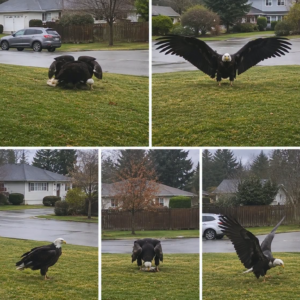
The discovery of an unusually large raptor near Brownsville, Texas, has attracted significant attention from scientists. Nicknamed the “Giant Eagle of the Border,” the bird reportedly has a wingspan of nearly 10 feet, making it much larger than typical North American eagles.
After hikers reported seeing the massive bird, wildlife experts used thermal imaging and GPS tracking to safely locate and capture it without causing harm. The raptor was then transported to a conservation center, where researchers began studying its DNA, physical characteristics, and overall health.
Scientists hope to determine whether the bird represents a previously unknown species, a rare subspecies, or an unusual genetic variation. They are also examining its feathers and diet to better understand its habitat, migration patterns, and possible impact on the local ecosystem.
The discovery has sparked interest beyond the scientific community. Local officials have discussed creating a conservation and research center that could also support ecotourism in the region. Whether the bird proves to be a remarkable new finding or an unusual individual, it has renewed public interest in wildlife research and the possibility that nature still holds surprising discoveries.